skip to navigation | skip to content


Programs Between the Flags - keeping patients safe

This program is current
Between the Flags - Keeping Patients Safe

The Clinical Excellence Commission (CEC) has worked in close collaboration with the Greater Metropolitan Clinical Taskforce (GMCT), an expert group of clinicians and the Clinical Safety, Quality and Governance Branch of the NSW Department of Health on developing the Between the Flags program. 

The program uses the analogy of Surf Life Saving Australia whose Lifeguards and Life Savers keep people safe by keeping them under close observation, and ensuring they do not venture into unsafe areas. They also ensure rescue is rapid, should anyone get into trouble.

The Between the Flags Guidelines and Implementation Toolkit is avaliable now.


Program Overview

Background

The Between the Flags Program is designed to establish a 'safety net' in all NSW public hospitals and healthcare facilities that reduces the risks of patients deteriorating unnoticed and ensures they receive appropriate care in response if they do.

The Program uses the analogy of Surf Life Saving Australia's Lifeguards and Life Savers who keep people safe by ensuring they are under close observation and rapidly rescue them, should something go wrong.

The Between the Flags Program has a Five Element Strategy, which is essential to its long-term sustainability.

  1. A governance structure in each Local Health Network and hospital in NSW to oversee the implementation and sustainability of the Program.
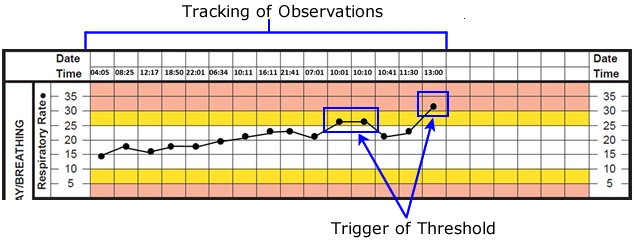
  2. Standards for the criteria used for early recognition of the deteriorating patient (clinical observation and 'track and trigger' system), incorporated in standard observation charts e.g. the Standard Adult General Observation Chart (SAGO).
  3. Standards for a process for escalation of concern and rapid response to the deteriorating patient (Clinical Emergency Response System).
  4. Education packages for all staff to give them the knowledge and skills to confidently recognise and manage the deteriorating patient.
  5. Standards for key performance indicators to be collected, collated and used to inform the users of the system and those managing the implementation and continuation of the Program.

Implementation

  • The Between the Flags state-wide rollout commenced in January 2010 with an announcement by the Minister for Health.
  • The five elements of the Program are being implemented throughout the State progressively.
  • The Between the Flags steering committee comprises experts from across NSW and oversees the state-wide implementation of the Program.
  • A Standard Adult General Observation (SAGO) Chart is in use across NSW.
  • An awareness presentation is available for use by all facilities as they rollout Between the Flags. This is available via NSW Health Moodle (www.nswmoodle.com.au) and other formats, and all clinical staff are required to complete it. 
  • DETECT education package 
    An education package, Detecting Deterioration Evaluation Treatment Escalation and Communication in Teams has been developed by NSW experts to address the training needs of the majority of staff who will be responsible for recognising and responding to deteriorating patients. This package is comprised of a course manual, e-learning materials and a workshop. Access to this package is via NSW Health Moodle - http://nswhealth.moodle.com.au
  • As part of the program, Clinical Emergency Response Systems (CERS) will be enhanced across NSW hospitals and a new focus placed on teamwork for patient safety.
  • Local Health Networks are implementing Between the Flags, including the SAGO Chart, education, Clinical Emergency Response Systems and formalisation of area referral and retrieval policies.
  • Local Health Networks are engaging with NSW Ambulance Service to formalise liaison agreements for support with providing rapid response, referral and retrieval.
  • All Local Health Networks have accredited DETECT Trainers.
  • The paediatric component of the Program is underway and the Paediatric Between the Flags steering committee, chaired by Professor Les White, is overseeing implementation.
  • A Maternity Chart, based on the SAGO Chart, has also been developed and includes modifications to reflect the specific needs of maternity patients requiring observations.
  • The Ministerial Taskforce on Emergency Care in NSW has endorsed the development of a standard observation chart for NSW which includes the Between the Flags standard observations for use in emergency departments.

What You Can Do

You can support your Local Health Network in implementing the 5 elements of the Between the Flags Program including contributing to and taking part in:

  • Your local planning and governance structures
  • Awareness raising for the Program about its importance, and implementing the SAGO Chart in your ward, department, facility or area
  • Developing your clinical emergency response systems and ensuring they are in place and working effectively
  • Understanding how to use the observation chart 'track and trigger' tool
  • Ensuring that you know what to do when a patient deteriorates
  • Ensuring that you know how to activate your Clinical Emergency Response System (CERS)
  • Managing deteriorating patients as part of the multidisciplinary team
  • Delivering or undertaking the education program, particularly the DETECT package
  • Collecting the information required to evaluate the Program

There is no member of the multidisciplinary team that cannot make a contribution to recognising and caring for patients who are deteriorating.

If you are unsure what to do, it is better to make a call for help.

Remember, you are the lifeguard, so:

  • Keep your patients 'Between the Flags'
  • Keep your patients safe!

Background and origins

The CEC in collaboration with the NSW Patient Safety, Quality and Governance Branch (formerly QSB) commenced Between the Flags to address the internationally recognised need for clinicians to identify and commence early management of deteriorating patients.

The early phase of the program commenced in November 2007 and included an initial project focusing on diagnostics, and a later phase identified, tested and evaluated possible solutions to this frequently-encountered problem.

  • The original project overview of Between the Flags (Published 14 November 2007) - PDF ~44kb | RTF ~7kb
  • The importance of this issue is undisputed, Council Of International Hospitals - PDF ~196kb | RTF ~40kb
  • The National Health Service in the UK has recently undertaken similar work to address this internationally recognised issue - PDF ~391kb | RTF ~68kb

According to Incident Management in the NSW Public Health System (IIMS) March 2007 data 1, 2 and 3, the majority of SAC 1 clinical incidents are attributable to the following top four identified factors across the spectrum of public hospitals:

  • Inadequate/poor communication (25%)
  • Lack of/poor compliance with policies and procedures (25%)
  • Knowledge, skills and competence issues (18%)
  • Problematic work environments/scheduling (14%)

The above data is further supported by an examination of the clinical management reviewed in 178 RCA's over a targeted three month period (Oct-06 to Dec-06) where the top three reasons for inadequate patient management leading to RCA1, 2 and 3 were identified through the following:

  • Clinician failure to properly diagnose (31%)
  • Clinician failure to institute the appropriate treatment (19%)
  • Management of complications (15%)

Project Participation

In undertaking this project, the CEC will commence working intensively with facilities across the state from a representative sample of facility types in the initial two phases of the project:

  • Tertiary (Principal Referral hospital)
  • Major Metropolitan hospital
  • Rural Base hospital
  • Rural hospital

Following a high level of interest and response to the EOI to participate in the project by all Area Health Services, five facilities were nominated - these facilities are:

  • St Vincent's Hospital, Sydney
  • Canterbury Hospital
  • Port Macquarie Base Hospital
  • Wagga Wagga Base Hospital
  • Macksville District Hospital

Initial Presentation

  • Presentation on the initial steps in the Recognition and Management of the Deteriorating Patient Project (RMDP)
    - PPT ~197kb | RTF ~3kb

Resources

Brochure

  • Program Brochure: Between the Flags - PDF ~260kb

Guidelines and Implementation Toolkit

This document provides tools and guidance for implementing the Between the Flags Program.

The Complete Toolkit

Sections of the Toolkit

Toolkit Appendix

Publications

Reports

  • Between the Flags: The Way Forward - PDF ~128kb | RTF ~154kb
    This report describes the agreed way forward to implement statewide change to help keep patients safe.
  • Between the Flags Interim Project Report - PDF ~1.63mb | TXT ~214kb
    A project report on the statewide initiative on the recognition and management of the deteriorating patient.

In the News

Not drowning, waving

Professor Cliff Hughes talks to Stewart Prins about the new Between the Flags program for responding to deteriorating patients in The NSW Doctor magazine. - Published, March 2010

Contact

Should you require any further information please do not hesitate to contact the following CEC staff coordinating this project:

Colette Duff                                                         Dr Charles Pain
Project Officer Between The Flags                   Director, Health Systems Improvement

Clinical Excellence Commission
Locked Bag A4062
Sydney South NSW 1235
(02) 9269 5514